Winlog SCADA and OPC UA: Industrial Communication for Industry 4.0
Sielco Sistemi —
Modern industrial automation requires more than simply collecting data from machines. A SCADA system for Industry 4.0 must connect PLCs, industrial devices, production software, databases and digital services while maintaining interoperability, scalability and secure data exchange.
This is where OPC UA plays a central role. Designed as a platform-independent architecture for industrial data exchange, OPC UA provides a standardized way for automation systems and software applications to communicate without requiring the SCADA system to know the proprietary communication protocol of every connected device.
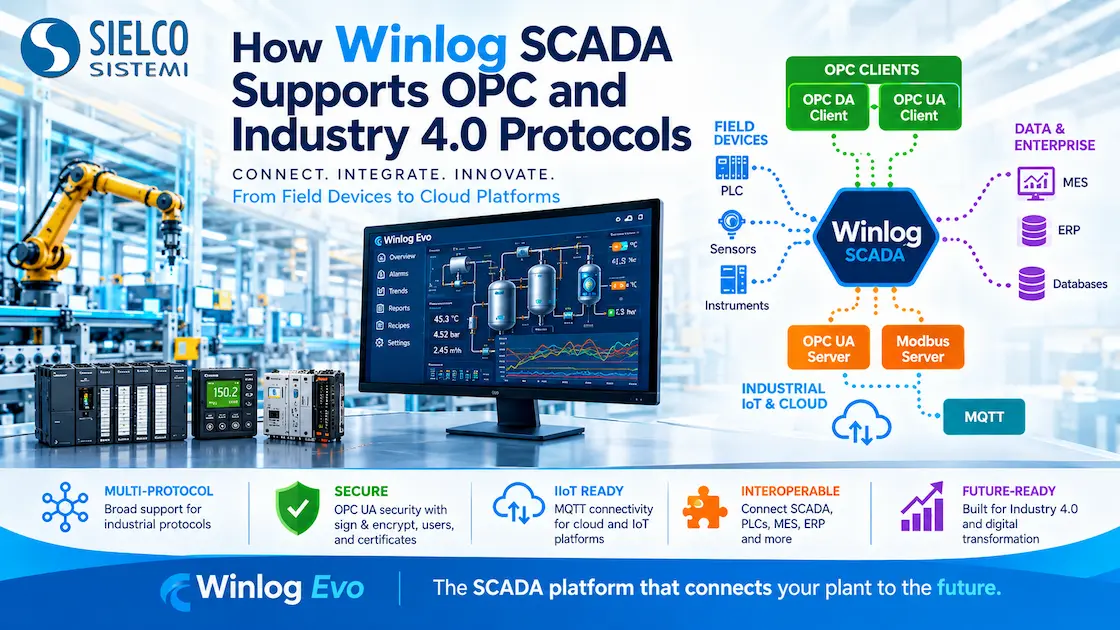
Winlog Evo, the SCADA/HMI platform developed by Sielco Sistemi, integrates OPC UA both as a Client and as a Server. This allows Winlog to exchange real-time industrial data in both directions: it can acquire information from OPC UA Servers and make selected SCADA variables available to other OPC UA Clients.
Learn more about Winlog Evo SCADA/HMI
Why OPC UA Is Important for Industry 4.0
OPC UA (Open Platform Communications Unified Architecture) is a communication technology developed to standardize and facilitate data exchange between industrial automation systems and higher-level applications such as PLCs, HMIs, MES and ERP systems.
Unlike a proprietary device driver, OPC UA provides an abstraction layer between the SCADA application and the underlying automation equipment. The OPC UA Server handles communication with the PLC or industrial device, while the SCADA application accesses standardized data exposed by that server.
OPC UA also provides important capabilities such as discovery, hierarchical address spaces, access-controlled read/write operations and subscriptions. These features make it particularly suitable for connected automation architectures.
For Winlog Evo, OPC UA is therefore more than another communication driver: it can act as an important interoperability layer between the SCADA system and the wider digital infrastructure of an industrial plant.
Winlog OPC UA Client: Connecting SCADA to Industrial Data
The Winlog OPC UA Client allows the SCADA application to access real-time data made available by OPC UA Servers. Communication takes place using the OPC UA binary protocol through an opc.tcp:// connection.
This approach means that Winlog does not need to know the specific communication protocol used by the PLC or device behind the OPC UA Server. The server handles the device-specific communication, while Winlog communicates with the standardized OPC UA interface.
In practical terms, this can simplify the integration of heterogeneous automation systems. A plant can contain PLCs and devices from different manufacturers while exposing their data through OPC UA Servers. Winlog can then access those variables through a consistent communication architecture.
The Winlog OPC UA Client supports numeric, digital and string variables and provides browsing functionality to simplify the identification of available OPC UA items.
OPC UA Address Space and Data Discovery in Winlog
One of the important characteristics of OPC UA is its structured address space. Data is represented using namespaces and node identifiers rather than only simple proprietary addresses.
Winlog supports OPC UA item addressing using the namespace and identifier structure defined by the OPC UA Server. For example, an item can be represented using a namespace index and a numeric or string identifier.
Winlog also provides a browsing function that displays the variables available on the OPC UA Server. In addition, the OPC UA item list can be downloaded so that application development can continue offline without requiring a connection to the OPC UA Server every time a new variable is added.
This can be especially useful when developing large SCADA applications with many OPC UA variables.
OPC UA Security in Winlog SCADA
Security is a fundamental requirement for connected industrial systems. The Winlog OPC UA Client includes dedicated security configuration options for OPC UA connections.
Supported security modes include None, Sign and Sign and Encrypt. With Sign, messages are digitally signed. With Sign and Encrypt, messages are both signed and encrypted.
The configuration also supports several OPC UA security policies and authentication methods including Anonymous, Username and Certificate. When certificate-based authentication is selected, the corresponding public key file can be configured.
These capabilities allow Winlog to participate in OPC UA architectures where data integrity, confidentiality and authenticated access are important requirements.
Winlog OPC UA Server: Sharing SCADA Data with Other Systems
Winlog Evo can also work in the opposite direction. Its OPC UA Server allows selected variables from the SCADA application to be shared with external OPC UA Clients.
This makes Winlog an active participant in an Industry 4.0 data architecture rather than simply a monitoring application.
The Winlog OPC UA Server can expose numeric, digital, string, compound, event and alarm gates. For each variable, the application can define whether it is shared as read/write, read-only or not shared. A separate browse name can also be assigned for the external OPC UA representation.
This means that production data collected and processed by Winlog can be made available to other industrial applications without creating a proprietary interface for each connection.
OPC UA Between SCADA, MES and ERP
A typical Industry 4.0 architecture can use OPC UA as the communication layer between the SCADA system and higher-level software.
For example, Winlog can collect production information from PLCs and industrial devices, process that information and manage alarms, trends and operator interfaces. Selected variables can then be exposed through the Winlog OPC UA Server to MES, ERP, analytics or other industrial applications.
Conversely, Winlog can use its OPC UA Client to consume information made available by another OPC UA Server.
This bidirectional capability is important because Industry 4.0 is not only about sending data upward. Modern architectures also require information and commands to move between different levels of the production and enterprise environment.
OPC DA and OPC UA: Supporting Existing and Modern Systems
Although OPC UA is the main focus of modern interoperability architectures, many industrial plants still rely on OPC DA. Winlog supports both technologies.
The Winlog OPC DA Client supports OPC DA Server versions 1.0, 2.0 and 3.0 and can connect to local or remote OPC Servers. This provides a practical migration path for existing automation installations.
Companies do not necessarily need to replace their existing OPC infrastructure when introducing a modern SCADA platform. Winlog can continue to communicate with OPC DA systems while also providing OPC UA connectivity for newer parts of the plant.
MQTT and OPC UA: Extending SCADA Toward Industrial IoT
OPC UA provides a strong interoperability layer inside industrial automation architectures, while MQTT can extend selected SCADA data toward IoT platforms and cloud infrastructures.
Winlog Evo includes an MQTT 3 driver capable of publishing and subscribing to MQTT v3.1.1 topics. Gate values can be published when they change, while incoming MQTT messages can update Winlog variables.
The driver supports simple text messages as well as JSON structures, making it possible to exchange structured data with IoT applications. Security options include TLS, certificates and MQTT username/password authentication.
A combined OPC UA + MQTT architecture can therefore provide a useful separation of roles: OPC UA can be used for standardized industrial interoperability, while MQTT can transport selected data toward Industrial IoT and cloud environments.
Building an Industry 4.0 Architecture with Winlog and OPC UA
A connected industrial architecture based on Winlog Evo can be organized into several layers:
- Field level: PLCs, sensors, instruments and controllers communicate with Winlog or OPC UA Servers.
- SCADA level: Winlog Evo supervises the process, manages alarms, trends, recipes, reports and operator interfaces.
- OPC UA interoperability level: Winlog operates as an OPC UA Client and/or Server to exchange standardized industrial data.
- Enterprise level: OPC UA can connect selected SCADA information with MES, ERP, analytics and other applications.
- Industrial IoT level: MQTT can publish selected data to brokers and cloud or IoT platforms.
This architecture allows manufacturers to integrate existing equipment while progressively introducing Industry 4.0 technologies.
Why Choose Winlog Evo for OPC UA and Industry 4.0?
The combination of OPC UA Client and OPC UA Server is one of the key strengths of Winlog Evo for connected industrial applications.
Winlog can consume standardized OPC UA data from external systems, expose its own SCADA variables through OPC UA, and simultaneously communicate with field devices using dedicated industrial drivers. MQTT can then extend the architecture toward Industrial IoT and cloud applications.
This makes Winlog Evo suitable for projects where interoperability is a central requirement and where the SCADA system must connect different generations of automation technology.
View Winlog Communication Drivers
Conclusion: OPC UA at the Core of Connected SCADA
OPC UA is a key technology for industrial interoperability and Industry 4.0 architectures. By supporting both OPC UA Client and OPC UA Server functionality, Winlog Evo can communicate in both directions across the industrial information architecture.
Winlog can acquire real-time data from OPC UA Servers, browse and manage OPC UA variables, use secure OPC UA connections and expose selected SCADA variables to external OPC UA Clients. At the same time, OPC DA support helps integrate existing installations, while MQTT provides a bridge toward Industrial IoT and cloud platforms.
The result is a flexible SCADA architecture in which machines, PLCs, Winlog, MES, ERP and IoT systems can exchange information through standardized communication technologies.
For manufacturers looking to modernize their automation infrastructure and build connected production systems, Winlog Evo provides a practical path toward OPC UA-based interoperability and Industry 4.0.
Discover Winlog Evo | Explore Winlog Communication Drivers
FAQ
- What is OPC UA and why does it matter for Industry 4.0
- OPC UA (Open Platform Communications Unified Architecture) is a platform-independent communication technology that standardizes data exchange between PLCs, SCADA, MES and ERP systems. It removes the need for a SCADA system to know each device’s proprietary protocol, which is essential for interoperable Industry 4.0 architectures.
- Can Winlog Evo work as both an OPC UA Client and an OPC UA Server
- Yes. Winlog Evo integrates OPC UA both as a Client, to acquire data from external OPC UA Servers, and as a Server, to expose selected SCADA variables to other OPC UA Clients such as MES or ERP systems, enabling bidirectional data exchange.
- What security options does the Winlog OPC UA Client support
- The Winlog OPC UA Client supports security modes None, Sign and Sign and Encrypt, along with authentication methods Anonymous, Username and Certificate, allowing data integrity, confidentiality and authenticated access to be configured according to plant requirements.
- Does Winlog still support older OPC DA systems alongside OPC UA
- Yes. The Winlog OPC DA Client supports OPC DA Server versions 1.0, 2.0 and 3.0 and can connect to local or remote OPC Servers, giving companies a practical migration path without having to replace existing OPC infrastructure when adopting OPC UA.
- How does Winlog combine OPC UA with MQTT for Industrial IoT
- Winlog Evo pairs OPC UA, used for standardized industrial interoperability, with an MQTT 3 driver that publishes and subscribes to MQTT v3.1.1 topics using text or JSON messages, secured with TLS, certificates or usernamepassword, extending selected SCADA data toward IoT platforms and the cloud.