Choosing the Right Modbus Gateway: SS10680-IOT-LOG vs. SS10680-MOD-LOG vs. SS10680-MOD
Sielco Sistemi —
Industrial plants increasingly need to move data reliably between field devices and the systems that monitor them — whether that means a local SCADA application, a cloud dashboard, or a simple historical log on a USB drive. That data almost always starts on an RS485 serial network speaking Modbus RTU, while the systems consuming it increasingly expect Ethernet, Wi-Fi, or MQTT. Bridging that gap is the job of a Modbus gateway.
Sielco Sistemi’s IOlog Adapters and Converters line includes three isolated gateway models built specifically for this role: the SS10680-IOT-LOG, the SS10680-MOD-LOG, and the SS10680-MOD. They share the same rugged, galvanically isolated hardware platform but differ in how — and how much — data they store, forward, and expose to the cloud. This guide breaks down what each one does and how to choose between them.
What Is a Modbus Gateway and Why It Matters for Industrial IoT
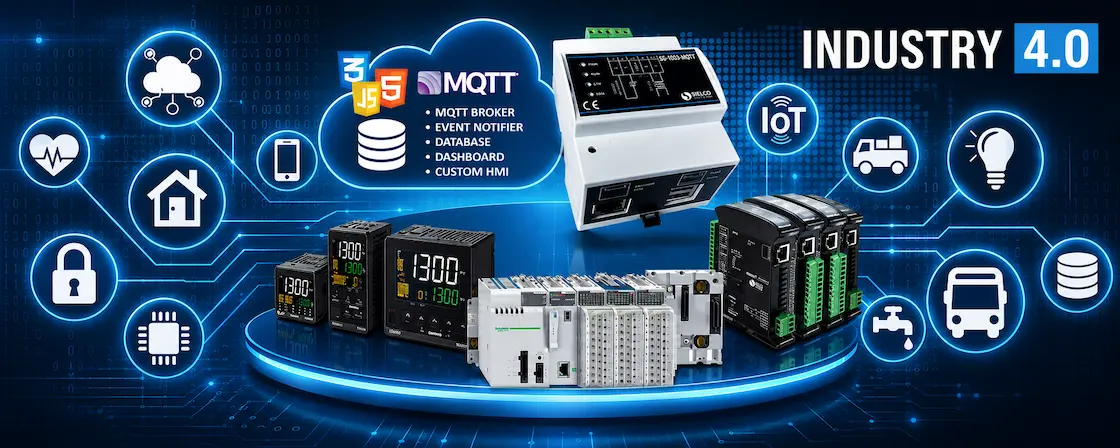
A Modbus gateway sits between two communication worlds. On one side, it speaks Modbus RTU over an RS485 serial line to connect sensors, PLCs, energy meters, and other field devices. On the other, it exposes that same data over Modbus TCP, FTP, or MQTT so it can reach a SCADA system, a database, or a cloud platform. This matters for industrial IoT projects because most legacy field instruments were never designed to talk to the internet directly — a gateway is what makes retrofitting them practical without replacing existing equipment.
All three SS10680 models are built around the same core promise: full galvanic isolation between the serial and network sides, which eliminates ground loops and protects the device against the electrical noise typical of industrial environments. Where they diverge is in connectivity and data-handling capability, which is exactly what makes choosing the right one worth a closer look.
SS10680-IOT-LOG: The IoT Modbus/MQTT Gateway Datalogger
The SS10680-IOT-LOG is the most capable of the three, purpose-built for data acquisition systems operating on the IoT paradigm. It combines an RS485 interface for Modbus RTU master communication with an Ethernet/Wi-Fi interface that supports Modbus TCP master, FTP, and MQTT protocols simultaneously.
Variables read from Modbus slave devices are published to the cloud via MQTT, secured with SSL/TLS client certificate authentication, and can be sent either on a variable’s change of value or at fixed intervals — a detail that matters for controlling bandwidth and cloud message costs. The MQTT message structure is configurable to match different brokers, including Amazon AWS and Mosquitto.
Crucially, the SS10680-IOT-LOG doesn’t only push data outward: its built-in datalogger function stores acquired data on a removable USB flash drive, and that same data can also be retrieved remotely over FTP. A web interface lets integrators define sampled variables from any Modbus device or select a preconfigured profile from Sielco’s device library, covering the SS3000, SS8000, and SS10000 IOlog module series. Configuration and firmware updates are both handled remotely through the same web interface — no on-site reprogramming required.
SS10680-MOD-LOG: Modbus Gateway With Local Data Storage
The SS10680-MOD-LOG covers the middle ground for applications that need reliable local logging without a cloud/MQTT connection. Like its IoT sibling, it reads Modbus RTU slave devices over RS485 and offers Ethernet/Wi-Fi connectivity for Modbus TCP master and FTP — but its focus is storage rather than live cloud publishing.
Data read from the field is recorded directly to a removable USB flash drive and can be pulled remotely via FTP whenever needed, making it well suited to sites with limited or unreliable internet connectivity where a continuous MQTT stream isn’t practical. The device can also function as a straightforward Modbus RTU to Modbus TCP gateway, and it shares the same web-based configuration, remote firmware updates, and device-library support as the SS10680-IOT-LOG.
SS10680-MOD: Isolated Modbus TCP/RTU Wi-Fi Gateway
The SS10680-MOD is the leanest of the three: a dedicated Modbus TCP to Modbus RTU gateway with no onboard datalogging or MQTT capability. It connects all Modbus RTU devices on an RS485 network to an Ethernet/Wi-Fi network using Modbus TCP, with the same complete electrical isolation that defines the whole SS10680 family.
Configuration happens through an integrated web interface covering both the Modbus TCP side (IP address, subnet mask) and the Modbus RTU side (baud rate, timeout), with a physical reset button available to restore factory settings. Ethernet activity LEDs and serial data-flow LEDs give installers an immediate, at-a-glance way to confirm the gateway is passing traffic correctly — useful during commissioning and troubleshooting alike.
Comparing the Three Gateways: Which One Fits Your Application?
- Need live cloud visibility and historical backup in one device? The SS10680-IOT-LOG is the only model of the three with MQTT publishing, making it the right choice for IoT dashboards and remote monitoring platforms alongside local logging.
- Need dependable local data capture without a cloud dependency? The SS10680-MOD-LOG logs to USB and serves files over FTP, ideal for sites where connectivity is intermittent or cloud services aren’t part of the architecture.
- Just need to bridge Modbus RTU devices onto an Ethernet/Wi-Fi network? The SS10680-MOD does exactly that, with nothing extra to configure — a good fit when a SCADA system or PLC already handles the data historian role.
Built for Harsh Industrial Environments: Isolation and Reliability
Whichever model fits the application, all three benefit from the same design philosophy: complete electrical isolation between the serial and network sides removes ground-loop risk and protects the gateway against the electrical noise common on factory floors, in substations, and in outdoor installations. Combined with remote, web-based configuration and firmware updates, the SS10680 series is designed to be deployed once and managed remotely for the life of the installation — a meaningful advantage for geographically distributed IoT fleets.
Getting Started with Sielco Sistemi’s IOlog Gateways
The SS10680-IOT-LOG, SS10680-MOD-LOG, and SS10680-MOD are all part of Sielco Sistemi’s broader IOlog range of industrial I/O and connectivity hardware, designed to work seamlessly alongside the Winlog SCADA/HMI software platform for a complete data acquisition and supervision solution. Full technical specifications, wiring diagrams, and configuration details for each model are available in the datasheets linked above, or on the Adapters and Converters product page.
For help selecting the right gateway for a specific plant or IoT architecture, Sielco Sistemi’s technical team can be reached at info@sielcosistemi.com or +39 031 899671.
FAQ
- What is the main difference between the SS10680-IOT-LOG and the SS10680-MOD-LOG?
- The SS10680-IOT-LOG adds MQTT cloud publishing on top of the local USB datalogging both models share, so it can push live data to a cloud broker while also keeping a historical log. The SS10680-MOD-LOG only stores data locally and via FTP, with no MQTT or cloud connectivity.
- Does the SS10680-MOD support MQTT or data logging?
- No. The SS10680-MOD is a straightforward Modbus TCP to Modbus RTU gateway with no onboard datalogging or MQTT capability. Its purpose is purely protocol conversion between the RS485/Modbus RTU field network and an Ethernet/Wi-Fi/Modbus TCP network.
- Which MQTT brokers are compatible with the SS10680-IOT-LOG?
- The SS10680-IOT-LOG’s MQTT message structure can be configured to work with different brokers, including Amazon AWS and Mosquitto, and connections are secured using SSL/TLS client certificate authentication.
- Can data from these gateways be retrieved without an internet connection?
- Yes. Both the SS10680-IOT-LOG and SS10680-MOD-LOG store data locally on a removable USB flash drive, which can also be retrieved remotely via FTP, making them suitable for sites with limited or unreliable internet connectivity.
- Are the SS10680 gateways suitable for harsh industrial environments?
- Yes. All three models - SS10680-IOT-LOG, SS10680-MOD-LOG, and SS10680-MOD - feature full galvanic isolation between the serial (RS485) and network sides, which removes ground-loop risk and protects the device from the electrical noise typical of industrial settings.